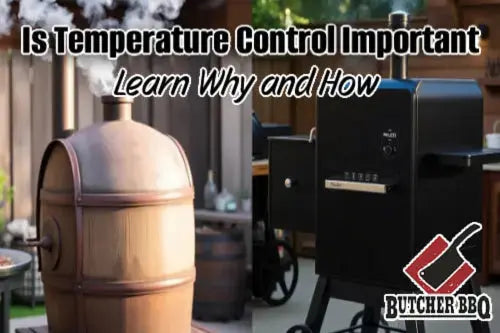
When you bite into a perfectly smoked brisket, with its tender, juicy meat and that beautiful smoke ring, you're tasting the result of countless decisions made during the smoking process. But here's the thing that separates the pitmasters from the backyard grillers: temperature control. It's not just important—it's absolutely fundamental to creating championship-quality BBQ. Whether you're a seasoned smoker or just getting started with your first rack of ribs, understanding why temperature control matters can transform your entire smoking experience.
Think about the last time you had truly exceptional BBQ. The meat was tender enough to pull apart with your fingers, the flavors were complex and layered, and every bite was consistent with the last. That didn't happen by accident. That happened because someone understood the critical relationship between temperature, time, smoke, and the final product on your plate. In this comprehensive guide, we're going to explore why temperature control is the foundation of great BBQ, how it works, and most importantly, how you can master it yourself.
Why Temperature Control Matters
Tenderness and Flavor Development
Let's start with the most obvious reason: temperature control directly impacts how your meat tastes and feels. When you smoke meat at the proper temperature, you're creating an environment where the proteins break down gradually, transforming tough muscle fibers into something tender and succulent. This process doesn't happen overnight, and it doesn't happen at just any temperature.
The magic happens in a specific temperature range. When you maintain consistent heat between 225 and 275 degrees Fahrenheit, you're allowing the collagen in the meat to convert into gelatin at just the right pace. Too hot, and the exterior of your meat will cook faster than the interior can break down, leaving you with a tough, dried-out exterior and an undercooked center. Too cool, and you're not generating enough heat to properly render the fat and develop those complex flavors that make BBQ so addictive.
But tenderness is only part of the equation. Flavor development is equally important, and it's directly tied to temperature control. When you maintain the right temperature, you're creating the ideal conditions for smoke to penetrate the meat. The smoke ring—that beautiful pink layer just under the surface of your brisket or ribs—is a visual indicator that your temperature control is working. It forms when nitrogen dioxide from the smoke reacts with myoglobin in the meat, and it only happens when conditions are just right.
The complex flavors in smoked meat come from the combination of smoke compounds, rendered fat, and the Maillard reaction happening on the surface. All of these processes are temperature-dependent. Get the temperature right, and you'll develop deep, complex flavors that keep people coming back for more. Get it wrong, and you'll end up with meat that's either bland or overly smoky in an unpleasant way.
Food Safety and Proper Internal Temperatures
Beyond taste and texture, temperature control is absolutely critical for food safety. This isn't just about following rules—it's about protecting the people you're serving from foodborne illness. Different meats require different internal temperatures to be considered safe for consumption, and these temperatures exist for a reason: they kill harmful bacteria that can cause serious illness.
For poultry, the safe internal temperature is 165 degrees Fahrenheit. For pork, it's 145 degrees Fahrenheit. For beef, the USDA recommends 160 degrees Fahrenheit for ground beef, but whole cuts like brisket and steaks can be served at lower temperatures because bacteria primarily live on the surface. However, when you're smoking meat, you need to understand that the low-and-slow process means the meat spends a long time in the danger zone between 40 and 140 degrees Fahrenheit.
This is where temperature control becomes a food safety issue. You need to move through that danger zone quickly enough to prevent bacterial growth, but slowly enough to allow proper cooking and flavor development. This is why maintaining consistent smoking temperatures is so important. If your temperature fluctuates wildly, you might spend too much time in the danger zone, or you might cook the exterior of your meat too quickly while leaving the interior undercooked.
Understanding the relationship between smoking temperature, cooking time, and food safety is essential. A properly controlled smoking process ensures that your meat reaches safe internal temperatures while developing the tenderness and flavor that makes it delicious. This is why experienced pitmasters are so meticulous about monitoring their smokers—they're not just chasing flavor, they're ensuring that every bite is safe to eat.
Quality Control and Consistency
If you've ever smoked meat multiple times, you've probably noticed that results can vary significantly from one cook to another. One brisket might be absolutely perfect, while the next one is dry or undercooked. The difference usually comes down to temperature control and consistency.
When you maintain precise temperature control, you create repeatable conditions that lead to consistent results. This is why restaurants and competition pitmasters are obsessed with temperature monitoring. They understand that consistency is what builds reputation and keeps customers coming back. If you serve amazing BBQ one week and mediocre BBQ the next week, people will remember the bad experience.
Temperature control allows you to dial in your process. You learn that your particular smoker, in your particular location, with your particular fuel source, produces the best results when you maintain a specific temperature range. You learn how long it takes for different cuts of meat to reach the proper internal temperature at that heat level. You develop a system that works, and then you can repeat it reliably.
This is especially important if you're ever thinking about selling your BBQ or entering competitions. Judges and customers expect consistency. They want to know that if they buy your brisket today, it will be just as good as the one they bought last month. Temperature control is the foundation that makes this consistency possible.
The Science Behind Temperature Control
How Temperature Affects Smoke Absorption
Understanding the science behind smoking is key to appreciating why temperature control matters so much. Smoke absorption isn't a simple process—it's actually quite complex, and temperature plays a crucial role in how much smoke flavor your meat actually absorbs.
When you smoke meat, you're exposing it to smoke particles and gases. These compounds need to penetrate the surface of the meat and bond with the proteins and fats to create that distinctive smoke flavor. The rate at which this happens is directly affected by temperature. At lower temperatures, smoke penetrates more slowly but more thoroughly. At higher temperatures, the process speeds up, but the penetration might not be as deep.
This is why the "low and slow" method is so effective for developing complex smoke flavor. By maintaining a lower temperature for a longer period, you're giving the smoke compounds time to really penetrate the meat. The smoke ring that forms is evidence of this process happening correctly. It's not just about flavor—it's about the smoke actually bonding with the meat at a molecular level.
However, there's a limit to how slow you can go. If your temperature drops too low, you're not generating enough heat to properly render the fat in the meat, and you're also spending too much time in the food safety danger zone. This is why most pitmasters stick to the 225-275 degree range for low-and-slow smoking. It's the sweet spot where you get excellent smoke penetration, proper fat rendering, and food safety, all while keeping cooking times reasonable.
Relationship Between Temperature, Airflow, and Smoke Control
Here's something that many beginning smokers don't realize: temperature control and smoke control are intimately connected. You can't really control one without controlling the other, and both are directly tied to airflow.
Think about how a smoker works. You have a heat source, usually charcoal or wood, that creates heat and smoke. That smoke needs to flow over the meat and then exit the smoker. The rate at which air flows through the smoker affects both the temperature and the amount of smoke. More airflow means hotter temperatures and less smoke. Less airflow means cooler temperatures and more smoke.
This is where things get interesting. If you want to maintain a specific temperature, you need to control the airflow. If your temperature is running too hot, you open the vents more to increase airflow and cool things down. If it's running too cool, you close the vents to reduce airflow and let the temperature rise. But here's the catch: when you adjust the vents to control temperature, you're also adjusting the amount of smoke.
This is why temperature control equals smoke control. You can't separate them. A skilled pitmaster understands this relationship intuitively. They know that if they need to cool down their smoker, opening the vents will not only lower the temperature but also increase airflow and reduce smoke. They account for this when making adjustments. They might add more wood to compensate for the increased airflow, or they might accept that they'll get less smoke flavor as a trade-off for hitting their target temperature.
This relationship is one of the reasons why smoking meat is as much art as it is science. You're constantly making small adjustments to maintain the balance between temperature and smoke that produces the best results.
The Maillard Reaction and Caramelization
At the surface of your meat, something magical is happening: the Maillard reaction. This is a chemical reaction between amino acids and reducing sugars that creates hundreds of new flavor compounds. It's responsible for the brown color on the surface of your meat and much of the complex flavor that makes BBQ so delicious.
The Maillard reaction happens most efficiently at temperatures between 300 and 330 degrees Fahrenheit. This is why many pitmasters use a technique called the "Texas crutch" or wrapping method. They smoke their meat at a lower temperature for most of the cook, then increase the temperature near the end to develop a better bark and more complex flavors on the surface.
Temperature control allows you to optimize this process. If you maintain too low a temperature throughout the entire cook, you might not develop enough of the Maillard reaction, and your bark will be thin and pale. If you go too hot too early, you'll develop a thick bark but the interior won't cook properly. By controlling temperature strategically throughout the cook, you can develop both a beautiful bark and a tender, juicy interior.
Caramelization is another important process that happens at the surface of your meat. This is the breakdown of sugars at high temperatures, creating new flavors and colors. Like the Maillard reaction, caramelization is temperature-dependent and happens most efficiently in a specific temperature range. Understanding these chemical processes helps explain why temperature control is so important—you're not just cooking meat, you're orchestrating a series of chemical reactions that create the final product.
Standard Smoking Temperatures
Ideal Temperature Ranges for Different Meats
Different cuts of meat benefit from different smoking temperatures. Understanding these ranges is essential for getting consistent, delicious results.
For beef brisket, the gold standard is 225 to 250 degrees Fahrenheit. This temperature range allows the collagen in the brisket to convert to gelatin slowly, creating that tender, juicy texture that makes a great brisket so special. At this temperature, a 12-pound brisket will typically take 12 to 16 hours to reach the proper internal temperature of 203 degrees Fahrenheit.
For pork ribs, many pitmasters prefer 225 to 275 degrees Fahrenheit. Ribs are more forgiving than brisket—they'll turn out well across a fairly wide temperature range. At 225 degrees, you're looking at 5 to 6 hours for baby back ribs. At 275 degrees, you can cut that down to 3 to 4 hours. The choice often depends on how much time you have and how much smoke flavor you want to develop.
For pork shoulder or butt, 225 to 250 degrees Fahrenheit is ideal. This cut has a lot of fat and connective tissue, similar to brisket, so it benefits from the low-and-slow approach. A 10-pound pork shoulder will typically take 10 to 12 hours at 225 degrees to reach the proper internal temperature of 190 to 205 degrees Fahrenheit.
For chicken, you can go a bit hotter. Many pitmasters smoke chicken at 275 to 325 degrees Fahrenheit. Chicken doesn't have as much connective tissue as beef or pork, so it doesn't need as long a cook. At 300 degrees, chicken breasts will be done in about 1.5 to 2 hours, and whole chickens in about 2.5 to 3 hours.
These temperature ranges aren't arbitrary—they're based on the science of how different meats cook and how their proteins and fats break down at different temperatures. By understanding these ranges, you can choose a temperature that matches your goals and your available time.
Understanding the Low and Slow Philosophy
The "low and slow" approach is one of the two fundamental philosophies in BBQ, and it's been proven to produce exceptional results for certain cuts of meat. When you smoke at low temperatures for extended periods, you're giving the meat time to break down gradually, resulting in maximum tenderness and smoke flavor penetration.
The low-and-slow method is ideal for tough cuts of meat that have a lot of connective tissue. Brisket, pork shoulder, and beef ribs all benefit tremendously from this approach. The extended cooking time allows the collagen to convert to gelatin, transforming a tough, chewy cut into something tender and succulent.
One of the advantages of low-and-slow smoking is that it's more forgiving of temperature fluctuations. If your temperature drifts up or down by 10 or 15 degrees, it won't dramatically affect the final product. The long cooking time means that small variations average out. This is why low-and-slow smoking is often recommended for beginners—it's more difficult to mess up.
However, low-and-slow smoking requires patience and time. A brisket can take 16 hours or more. A pork shoulder can take 12 hours. If you don't have that kind of time, you might need to consider a different approach.
When to Use Hot and Fast Methods
The other fundamental philosophy in BBQ is "hot and fast." This approach uses higher temperatures, typically 300 to 350 degrees Fahrenheit, to cook meat more quickly. Instead of a 16-hour brisket cook, you might have a finished brisket in 8 to 10 hours. Instead of a 12-hour pork shoulder, you might be done in 6 to 8 hours.
Hot-and-fast smoking works well for certain cuts and certain situations. Chicken, for example, cooks beautifully at higher temperatures and doesn't require the extended cooking time that beef or pork does. Ribs can also turn out great with the hot-and-fast method, especially if you're short on time.
The hot-and-fast method also works well for leaner cuts of meat that don't have as much connective tissue to break down. A beef tenderloin, for example, would be ruined by a 16-hour low-and-slow cook—it would dry out. A hot-and-fast approach at 325 to 350 degrees would be much more appropriate.
However, hot-and-fast smoking requires more precise temperature control. Because the cooking time is shorter, temperature fluctuations have a bigger impact on the final product. If your temperature drifts too high, you might dry out the meat. If it drifts too low, you might not reach the proper internal temperature in your target timeframe.
Comparison of Both Approaches
So which approach is better? The honest answer is that it depends on what you're cooking and what your goals are. Low-and-slow is better for developing maximum tenderness and smoke flavor in tough cuts. Hot-and-fast is better for cooking quickly and for cuts that don't benefit from extended cooking times.
Many experienced pitmasters use both approaches depending on the situation. They might low-and-slow a brisket on a weekend when they have time, but hot-and-fast some ribs on a weeknight when they're short on time. They understand that temperature control allows them to adapt their method to their circumstances.
The key insight is that both methods require proper temperature control. Whether you're smoking at 225 degrees or 325 degrees, maintaining that temperature consistently is what separates great BBQ from mediocre BBQ. The specific temperature you choose should be based on the cut of meat, your available time, and your desired results.
The Dangers of Improper Heat
How Excessive Heat Harms Food Quality
One of the biggest mistakes beginning smokers make is running their smoker too hot. They think that higher temperatures will cook the meat faster and produce better results. In reality, excessive heat is one of the quickest ways to ruin a perfectly good piece of meat.
When you smoke at temperatures that are too high, the exterior of the meat cooks much faster than the interior. This creates a situation where the outside is already well-done while the inside is still raw. You end up with a hard, overcooked exterior and an undercooked, tough interior. This is the opposite of what you want.
Additionally, excessive heat causes the meat to lose moisture rapidly. The proteins on the surface contract and squeeze out the juices. Instead of a juicy, tender final product, you end up with something dry and tough. This is especially problematic with lean cuts of meat that don't have much fat to begin with.
Excessive heat also interferes with smoke absorption. Remember how we talked about the relationship between temperature and smoke penetration? At very high temperatures, the smoke doesn't have time to properly bond with the meat. You might end up with a heavy, acrid smoke flavor that's unpleasant rather than the subtle, complex smoke flavor you're after.